Showing posts with label pulau hantu. Show all posts

Monday, August 13, 2012

Pulau Hantu

This trip started the earliest of all the trips. We had to reach school at 3.30am this time. It was a quiet bus ride there, everyone was half awake. The boat ride was even quieter. It was so dark inside the boat everyone was sleeping. Everyone. Well at least everyone in JAWCH.

We arrived at Pulau Hantu before 7am and the sky was still dark. It was a rather small island compared to Pulau Semakau, and it's heard to be HAUNTED. Of course, we didn't see any ghosts or anything haha. According to our guide, Pulau Hantu is made up of two islets Pulau Hantu Besar and Pulau Hantu Kechil that is separated by a small lagoon. And despite its unattractive name, it is a favourite place for recreational activities such as fishing and snorkelling and is home to a variety of corals reefs.

Walked to the toilet and changed into our booties. Saw this humongous centipede just before setting off! We turned on our torches and followed our guide closely to the intertidal area. We saw many different shells, crabs and snails there. It was so dark and everything, but with out torches, we saw the place teeming with life! :)

They are mating.

Saw many marine organisms and took quite a lot of photos. We saw the horseshoe crab for the first time and it was really cute! We were all very amused when we found out from our guide, Tammy, that their bloods are BLUE in colour :O This is because unlike humans, horseshoe crab's blood do not contain hemoglobin but instead contain hemocyanin as an oxygen-carrier. Due to the copper content in hemocyanin, the blood is blue in coloration.

Continued our journey as the sun began to rise~ It was so pretty! Though Semakau's weather is still the best.

Some familiar sights
Oh look! A monkey!
We were hoping the monkey wouldn't go to the buckets of marine organisms the people prepared for us before us, and make a meal out of them :P We were told they are regularly seen in the shores feeding on shellfish and other marine organisms during low tide
Beautiful sunrise ain't it?
A sea star that unfortunately, didn't regenerate its 5th arm :(
A shrimp! A snapping shrimp if I remember correctly...
Mass of snail eggs...it's squishy xD
Many many corals~
It looks kinda like broccoli right? haha
We were very very lucky and came across a sea snake! It was like the main star of that period of time for every group. Everyone was just staring at it non-stop. It was on its way back into the water but it was pretty far so we had to wait for it to move further down the intertidal area before we could continue out journey, since it's a dangerous creature and can possibly harm any of us...
There's a tiny crab there
More topshells!
AN OCTOPUS OUT OF WATER!
It's on it's way back into somewhere damp haha it's really cute how it travels on land and in shallow waters, with one of its tentacles (the leading tentacle) sensing which direction it can/cannot go to. It's really cool how that tentacle can sense so many things, from directions, to sizes of gaps/holes to "calculate" whether it can fit in them when they're trying to hide or run away. With their awesome camouflaging skills, no wonder it's so tough to catch them!
It's either a dead jellyfish, or a coral hmm...
Another moon snail. Pretty but violent! -penis fencing-
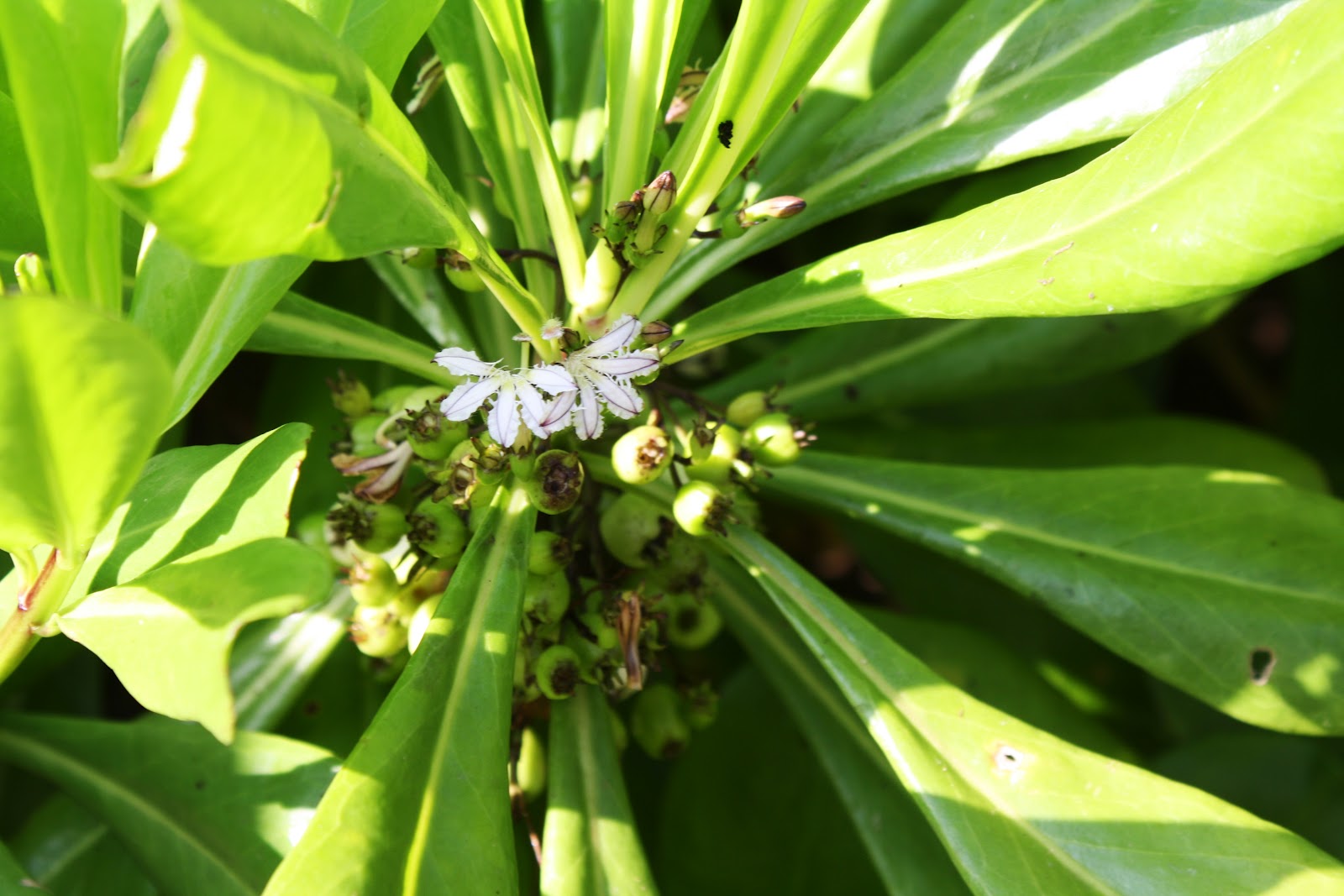
Just a plant that grows at the edge of the shore. It's fruit juice is known to be a substitute for eyedrops! We took a few, but none of us were daring enough to try it on our eyes :P
Played a "kampong game" with the leaves of this tree. Our guide introduced it to us. Most of us were like "they played this?! They must have been so bored.." haha xD

Pulau Hantu was really nice :) The weather was just slightly more cooling than mainland Singapore's but it was still not as cooling and windy as Pulau Semakau! It was nice going for the intertidal walk early in the morning when the sun hasn't rose yet since we got to see a really wonderful sunrise. Our group photo was taken during the sunrise too!

As Pulau Hantu has a sandy shore like Pulau Semakau, the organisms we observed on the shores of both islands were pretty similar. The highlight of this trip was the octopus, horseshoe crab, sea snake, monkey and kingfisher. It is amazing how such a wide diversity of organisms can be found in such a remote and small island. We were lucky we didnt get bitten by a snake or bashed by a monkey :b In the next 2 wks we will be visiting the 1st rocky shore that is in St John Island so the diversity of organisms will be slightly different so we cant wait XD

Sunday, August 5, 2012

Tachypleus gigas

Coastal Horseshoe crab
Scientific classification
Kingdom:Animalia
Phylum:Arthropoda
Class:Merostomata
Order:Xiphosura
Family:Limulidae
Genus:Tachypleus
Species:T. gigas
Binomial name
Tachypleus gigas
(Müller, 1785)
Despite its name of horseshoe crab, it is more closely related to spiders, ticks, and scorpions than to crabs.

Despite its threatening...? CUTE!! appearance, the horseshoe crab is harmless, and its long, spike-like tail is not poisonous, as many people think. It uses its tail to plow itself through the sand and muck and also as a lever to right itself when it has been overturned by a wave or a thoughtless person:D


The horseshoe crab's blood is BLUE:O It is because of a chemical reaction between copper and an oxygen-carrying protein called hemocyanin.
Shoot of the new mangrove tree
Dead flower crab... Poor thing D:
one of the empty shell:P

Family Parthenopidae

Elbow crab
Scientific classification
Kingdom:Animalia
Phylum:Arthropoda
Subphylum:Crustacea
Class:Malacostraca
Order:Decapoda
Infraorder:Brachyura
Section:Eubrachyura
Subsection:Heterotremata
Superfamily:Parthenopoidea
Macleay, 1838
Family:Parthenopidae
Macleay, 1838

Family Gobiidae

Mudskipper
Scientific classification
Kingdom:Animalia
Phylum:Chordata
Superclass:Osteichthyes
Class:Actinopterygii
Superorder:Acanthopterygii
Order:Perciformes
Suborder:Gobioidei
Family:Gobiidae
How do they breathe out of water? While out of water, they breathe by retaining water in enlarged gill chambers. Just as we bring tanks of air to breathe from when we scuba dive, mudskippers bring stores of water. They can also breathe air through their wet skin. These fish are in fact more comfortable crawling around on the mud than submerged in water!

Mudskippers have interesting features designed to rule the mud! They have eyes at the top of the head for an all-round view. While their mouth faces downwards to feed on the mud surface. In some mudskippers, the pelvic fins are fused to form a sucker so they can better cling to rocks and roots. Their pectoral fins are used like crutches to crawl over mud. Some have colourful dorsal fins that can be raised to signal other mudskippers on the sand or mudflats.

They curl their muscular body sideways then push against the mud to spring forward.


Credits: http://www.wildsingapore.com/wildfacts/vertebrates/fish/gobiidae/mudskipper.htm

Family Alpheidae

Snapping shrimp
Scientific classification
Kingdom:Animalia
Phylum:Arthropoda
Subphylum:Crustacea
Class:Malacostraca
Order:Decapoda
Infraorder:Caridea
Superfamily:Alpheoidea
Family:Alpheidae
Rafinesque, 1815
These little creatures make the incessant pops that you hear at low tide. They are found on sand, mudflats and coral rubble. They range from tiny ones to rather large ones that can pack a really loud pop. Some even hide under carpet anemones and inside sponges or other animals. During the day, the snapping shrimp hides in a burrow, sometimes renovating it quietly. It forages more actively at night.

The snapping sound is not made by the fingers actually hitting each other. Rather, a high-speed jet of water shoots out due to the extremely rapid compression of the fingers. This jet vapourises the water and creates a bubble. When the bubble collapses, the sound results. Not only that, a flash of light is also emitted! These findings are possibly useful for naval applications as the sound of snapping shrimps seriously interfere with sonar detection in shallow seas. In fact, snapping shrimps have been studied since World War II as their sounds interfered with the detection of hostile submarines!


Credits: http://www.wildsingapore.com/wildfacts/crustacea/othercrust/shrimp/alpheidae.htm

Phylum Nemertea

Red Ribbon worm
Scientific classification
Kingdom:Animalia
Superphylum:Lophotrochozoa
Phylum:Nemertea
Schultze, 1851

Most ribbon worms are voracious predators, often specialising in a particular prey although some will eat a wide variety of prey including other worms, crustaceans and molluscs.

Laticauda colubrina

Banded Sea Krait
Scientific classification
Kingdom:Animalia
Phylum:Chordata
Class:Reptilia
Order:Squamata
Suborder:Serpentes
Family:Hydrophiidae or Elapidae
Genus:Laticauda
Species:L. colubrina
Binomial name
Laticauda colubrina
(Schneider, 1799)
Banded Sea Kraits are white with black stripes. Or black with white stripes if you like to look at it that way.
They're a sea snake, highly venomous, but only aggressive when provoked repeatedly.