
Finally a trip where we can wake up relatively later. For our underwater world trip, we had to assemble in school at 9.15 which is the latest so far so we could finally get a good night's sleep. The bus came late blehh but the ride to sentosa was pretty quick and we didnt sleep as it was quite late in the morning already. At least most of us didnt sleep HAHA
We arrived in the Underwater World after 10 so we only had less than an hour to look around before we had to attend a dolphin-seal show. We had to use this limited time wisely as we were supposed to have a longer trip that was cut short because of the bus ._.
We spent the 1st 10 minutes at the ray touch pool. Here, we could literally stick our hands into a pool of water filled with non-venomous rays. It should be quite safe if not the UW would be sued by now after so many years of operation. They rays were in a variety of species and had different textures and patterns on their bodies. Most were really big (almost if not bigger than our torsos) and were smooth to touch, their non-venomous tails thrashing around still looked menacing to us. We got ourselves a little wet after the irritated rays splashed some water onto us so we had to wash up :D
Near the ray pool is a shark pool which is of course a non-touch pool. Unless you want to get your fingers bitten off that is. Again there is a variety of baby sharks housed in the pool which have different appearances and patterns on their bodies. Too bad we cant feel and touch them like the rays :( we were really tempted to touch them until we saw the warning sign
Near the entrance is a gallery of very interesting organisms. There were chances for us to feed some of the fish there as well. We didn't realise that until we saw the fish food machine and thought the hand hole was for us to touch the fish!


What are sea angels hmmm? Apparently they are hermaphroditic jellyfish-like organisms deep under the sea that are not actual jellyfish but sea slugs that have lost their shells and adapted from it. They angel-like "wings" that help them move in the water and their glowing heads give them their unique name. These organisms must be pretty valuable and hard to find as they are in a separate exhibit on its own even though there are only a few of them and each measure only a few cm.


Then we proceeded into the main exhibit of the UW which has the huge variety of marine organisms that ordinary folk cant find unless they scuba-dive or hop on a marine vessel. The start of the trail tried to explain the emergence of marine life on Earth and had a few fossilized shells that looked faked in our opinion :b surrounding this a few tanks containing a variety of fishes and huge horseshoe crabs
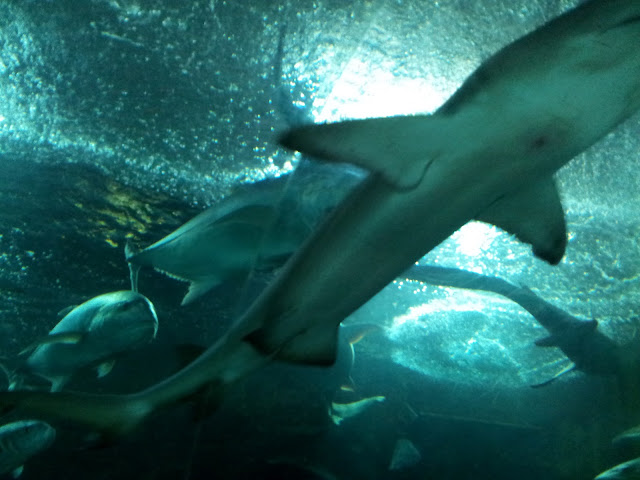
Deeper into the UW trail, more extravagant organisms can be found such as a huge master of camouflage that is the octopus and many different crabs, shrimp, fishes,etc. There were many unique organisms we have never heard of in our lives. Like a nautilus or a dugong for example. The main attraction of the UW is the moving tunnel where we can see a whole ecosystem of marine organisms living together in harmony, or so it seems. The waters are filled with sharks and everytime we look up, we see a shark opening its mouth and ripping another fish to shreds ._. its tough to live out in the wild we guess




We didnt get to see the whole of the UW thoroughly because of the limited time and we had to go for the dolphin show already. We had to walk outside the UW to a place where a few dolphins and seals are housed. The show was pretty interesting and we saw the dolphins and seals doing tricks and interacting with humans. It was kind of cute how the dolphin sadly waved goodbye to a new human friend


This trip to the UW was pretty enriching as we saw a huge variety of organisms that we never could hope of seeing in the shorelines. But the negative pt is that we couldnt feel and touch the organisms unlike in the shorelines and the experience wasnt exactly very hands on. We pretty muched preferred going to the islands like Pulau Semakau where we could really "interact" with the marine organisms more xD


