Showing posts with label st john's island. Show all posts
Tuesday, August 14, 2012
Organisms living on this huge rock
| Scientific classification | |
|---|---|
| Kingdom: | Animalia |
| Phylum: | Mollusca |
| Class: | Gastropoda |
| (unranked): | clade Caenogastropoda clade Hypsogastropoda clade Littorinimorpha |
| Superfamily: | Littorinoidea |
| Family: | Littorinidae |
| Genus: | Littorina |
| Species: | Littorina littorea |
| Binomial name | |
| Littorina littorea (Linnaeus, 1758)[1] | |
| Scientific classification | |
|---|---|
| Kingdom: | Animalia |
| Phylum: | Arthropoda |
| Subphylum: | Crustacea |
| Class: | Maxillopoda |
| Subclass: | Thecostraca |
| Infraclass: | Cirripedia Burmeister, 1834 |
Hermodice carunculata
Hermodice carunculata (commonly known as bearded fireworm)
| Scientific classification | |
|---|---|
| Kingdom: | Animalia |
| Phylum: | Annelida |
| Class: | "Polychaeta" |
| Order: | Aciculata |
| Family: | Amphinomidae |
| Genus: | Hermodice |
| Species: | H. carunculata |
| Binomial name | |
| Hermodice carunculata (Pallas, 1766) | |
Sea cucumbers!
Sea cucumbers (class Holothuroidea)
| Scientific classification | |
|---|---|
| Kingdom: | Animalia |
| Phylum: | Echinodermata |
| Subphylum: | Echinozoa |
| Class: | Holothuroidea de Blainville, 1834 |
Sentinel Crab :)
Macrophthalmus sp. ( also known as Sentinel Crab)
Phylum Arthropoda > Subphylum Crustacea > Class Malacostraca > Order Decapoda > Brachyurans > Superfamily Ocypodoidea
Protruding eyes which are there telltale signs
Goby Fish
Goby Fish
| Kingdom: | Animalia |
| Phylum: | Chordata |
| Class: | Actinopterygii |
| Order: | Perciformes |
| Suborder: | Gobioidei |
| Family: | Gobiidae |
Atergatis integerrimus
| Kingdom: | Animalia |
| Phylum: | Chordata |
| Class: | Actinopterygii |
| Order: | Perciformes |
| Suborder: | Gobioidei |
| Family: | Gobiidae |
Where seen? This colourful round crab can be very commonly seen on many of our shores in coral rubble areas and reefs. Slow moving, it usually hides under large coral rubble pieces, but can be quite active at night.
Features: Body width 8-10cm. Large oval body that is reddish brown, orangey to bright red, with small white spots all over. Large pincers have black tips that are spoon-shaped. Males may have larger claws. Like most other Xanthid crabs, it is highly poisonous and should not be eaten.
Tiger tailed Seahorse :D
Tiger-Tailed Seahorse
| Kingdom: | Animalia |
| Phylum: | Chordata |
| Class: | Actinopterygii |
| Order: | Gasterosteiformes |
| Family: | Syngnathidae |
| Genus: | Hippocampus |
| Species: | H. comes |
Moon snail shell!
More details in http://jawch.blogspot.sg/2012/07/blog-post_3658.html Insteresting to see it again :)
Holothuria atra
Holothuria atra (commonly known as Black sea cucumber)
| Scientific classification | |
|---|---|
| Kingdom: | Animalia |
| Phylum: | Echinodermata |
| Class: | Holothuroidea |
| Order: | Aspidochirotida |
| Family: | Holothuriidae |
| Genus: | Holothuria |
| Species: | H. atra |
| Binomial name | |
| Holothuria atra Jaeger, 1833 [1] | |
Brittle stars
More details in http://jawch.blogspot.sg/2012/07/blog-post_4806.html a sea star like any other, though quite brittle :/
Sea urchin
Sea urchins (phylum echinoderm )
very beautiful little thing which is similar to star fishes
| Scientific classification | |
|---|---|
| Kingdom: | Animalia |
| Phylum: | Echinodermata |
| Subphylum: | Echinozoa |
| Class: | Echinoidea Leske, 1778 |
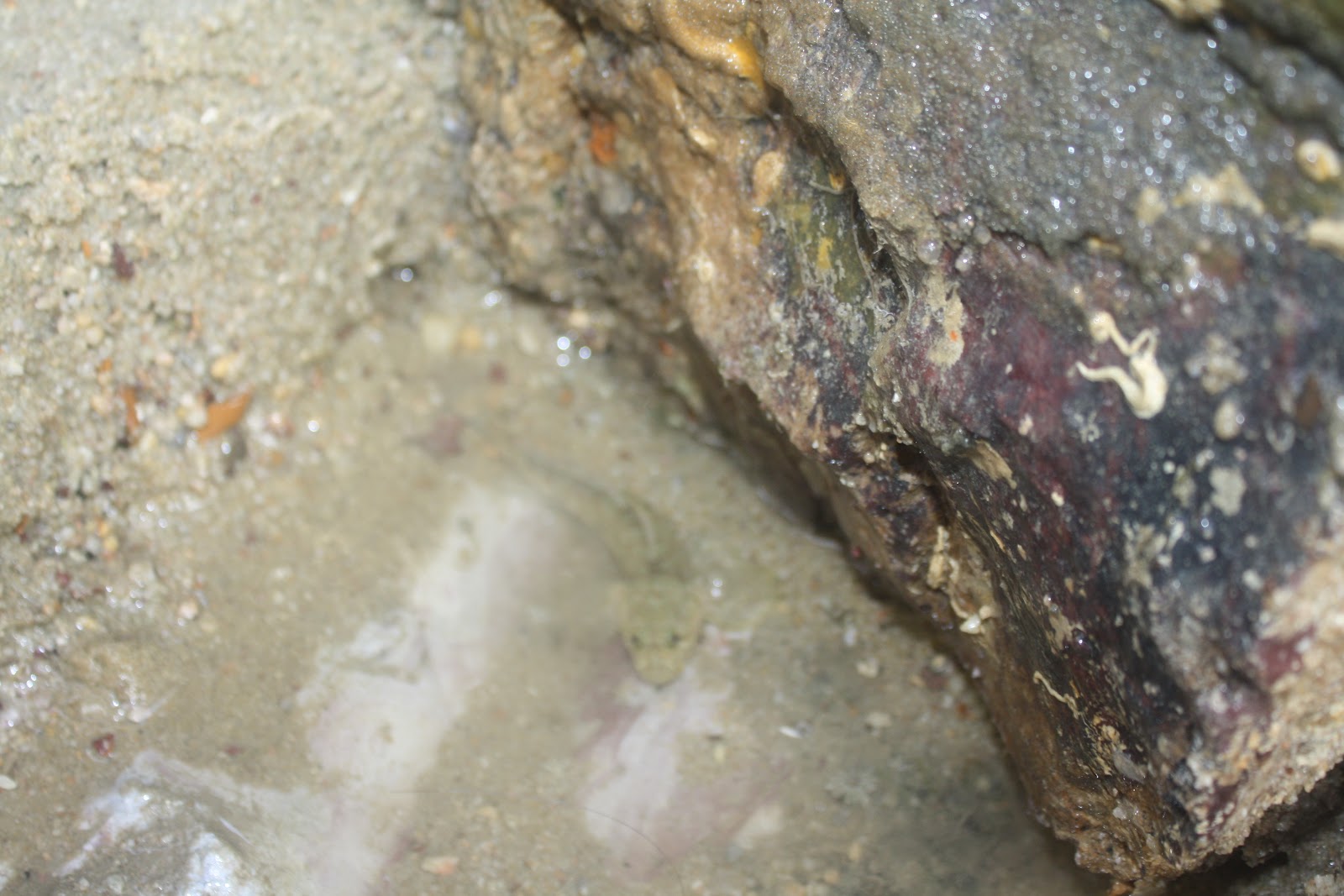
Goby
Goby (family Gobiidae)
another one :D, a very important species in this ecosystem
| Scientific classification | |
|---|---|
| Kingdom: | Animalia |
| Phylum: | Chordata |
| Class: | Actinopterygii |
| Order: | Perciformes |
| Suborder: | Gobioidei |
| Family: | Gobiidae Regan, 1911 |
St John's Island
Again we had to wake up early for this trip to St John's Island. We had to reach school at 4.15 which is a far cry from 9.15 the previous week :( We were half-zombies in both the bus and the boat ride but luckily the boat ride this time was only half an hour as St John's Island is closer to the Singapore mainland.
It was past 5.30 by the time we reached St. John's island and by the time we changed into our booties and prepared for the intertidal walk, it was already 6. Sunrise was only until another 40 minutes so it was extremely dark and we had to use multiple torchlights to illuminate the path and slowly thread our way through the rocky environment. At one point, we even had to scale down a rocky slope to reach the shoreline area in pitch darkness if not for the torchlight ._. We were really scared something bad was going to happen given to slipperyness due to algae overgrowth but thakfully nothing did.
For this trip, our guides wanted to give us more hands on experience so we were given gloves and water containers to find and retrieve marine organisms that we come across on our own.
Our guides also did not want to talk much and let us do the explaining ourselves. We felt we did a pretty good job trying to explain the marine organisms under a rock for example such as their mode of feeding and reproduction by its appearance and structure. Many of these organisms clump together in a small group for survival purposes. As they say, united we stand, divided we fall.
St John Island is pretty different from our previous two visits to Pulau Semakau and Pulau Hantu. As this is a rocky shore, the organisms we come across will no doubt be slightly different. With the effect of the tides in a rocky shore, the sea brings plankton and broken organic matter in with each tide. The availability of light and nutrient levels means that producers such as algae can grow effectively which will benefit the food web. The rocky outposts also can provide an area of refuge for marine organisms.
Many marine organisms use shells, holdfasts or a thick mucous layer to provide stability against strong wave actions that can result in desiccation or dehydration especially during low tides. The crevices in the rocks in the shores can also contribute to being containers of pollution due to human action. As such there are many advantages and disadvantages of living in a rocky shore but the organisms here have adapted to this.
The almost full moon with surrounding islands
A shell :)
| CUTE HERMIT CRAB :D |
| Lalang, very nice to touch :) |
| Cat, made us really excited |
Leaving St John Island. Really going to miss it. Hope we can go back there sometime.
Subscribe to:
Posts (Atom)